
Phone systems for Fremont businesses that run an office and a warehouse at the same address
Fremont's industrial parks are full of companies where the office is at the front, the floor or the racks are at the back, and the person who needs to take a call is not always near a desk. Cloud phone service covers that whole building over your network — with wireless handsets where the work is, without adding a phone company visit every time a role changes.
- Coverage from reception to receiving, on one system and one number
- Mobile and wireless handsets for people who never sit at a desk
- Analog devices — fax, paging, alarm lines — handled rather than forgotten
On-site across the Bay Area · Remote anywhere in California · No obligation, no pressure
What Fremont operations run into
Industrial and distribution sites have phone problems that pure offices never see. These are the four we are called about most.
The call rings the office while the person is on the floor
A shipping manager, plant supervisor or warehouse lead is walking a 40,000 square foot building, and the only phone that rings is at a desk they left twenty minutes ago.
Wireless handsets registered to the same extension as the desk phone, plus mobile apps for supervisors, so the call follows the person through the building rather than waiting for them to walk back.
Analog devices nobody wants to talk about
Overhead paging, a fax machine the customers still use, alarm and lift-gate lines — all hanging off old copper that half works and cannot be ordered the same way anymore.
We inventory every analog device, keep what makes sense on adapters or dedicated lines, and move what can move to digital. You get a written list of what stayed analog and why.
One number for sales, service, shipping and receiving
Everything arrives on the main line, so the person answering becomes a switchboard and customer calls wait behind supplier calls.
Separate numbers for sales, service, shipping and receiving, each with its own ring group and hours. Callers reach the department they need, and each one has its own reporting.
Moving into a unit with unknown wiring
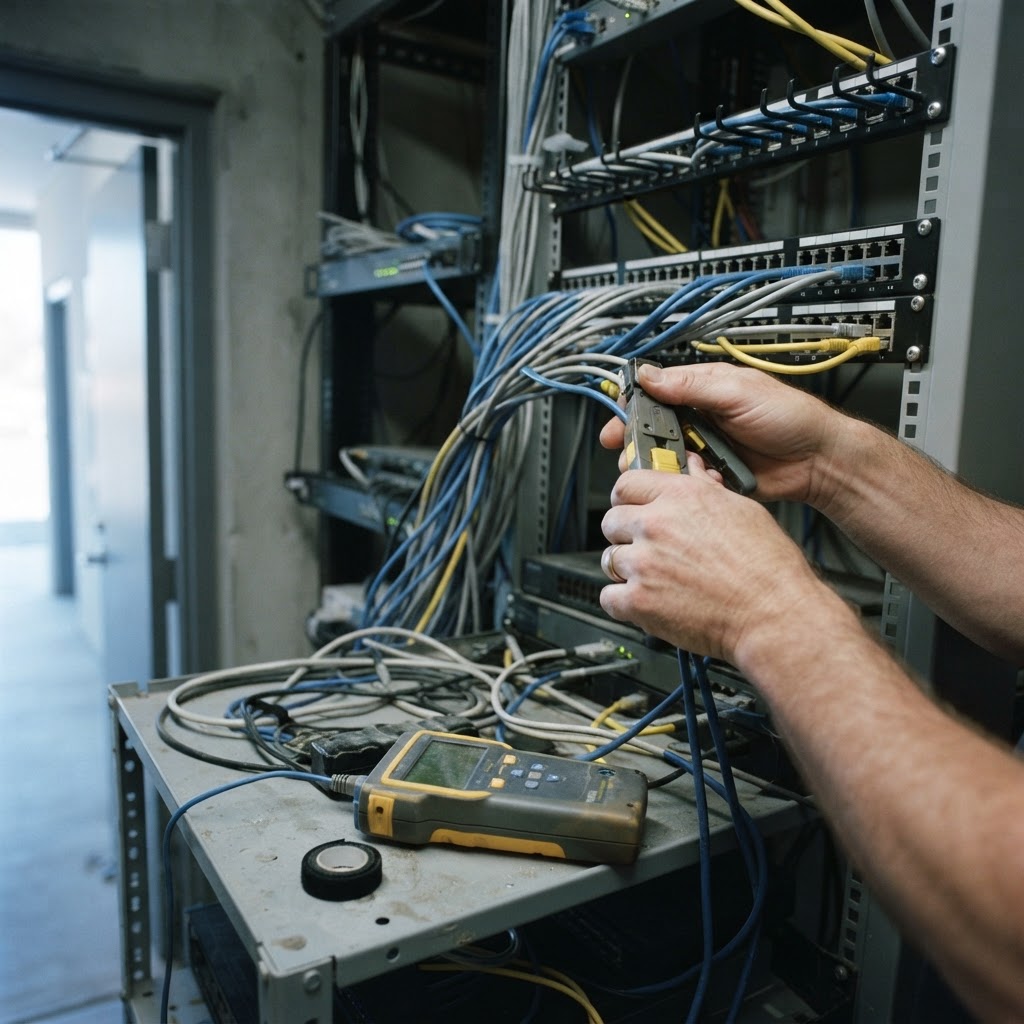
Industrial units change hands often, and the cabling, punch-down blocks and demarcation rarely match the last tenant's setup.
A site survey before quoting tells you what can be reused and what needs running, so the installation is planned around your operation instead of interrupting it.
What you gain with VoIP in Fremont
One system, whole site
Reception, offices, shop floor and warehouse on the same dial plan and directory.
Coverage for field crews
Installers and drivers answer on the company number from a van or a customer site.
Built on your network
Voice prioritized on the same infrastructure your systems already use, with switch capacity checked first.
Departments keep their numbers
Sales, service, shipping and receiving each have a published number and their own call flow.
Local support
An East Bay team that can come to the site when it matters, not just open a ticket.
Features we configure first
Platforms can do a great deal. These are the capabilities that change day-to-day operations for this kind of setup.
Extensions and direct dials
An extension for every desk role, with published numbers for the people customers call repeatedly.
DECT / wireless handsets
Roam the building with a real handset on your extension, without relying on Wi-Fi coverage alone.
Mobile apps
Supervisors and field staff answer on the company number from anywhere in the yard or on the road.
Overhead paging and adapters
Keep the paging and analog devices your operation depends on by connecting them properly instead of hoping they still work.
Ring groups by department
Sales, service, shipping and receiving each ring their own team so nothing waits behind the wrong call.
Auto attendant
Route suppliers and customers to the right department before a person picks up.
After-hours routing
Send calls to an on-call sequence when the office closes but the operation does not.

Fremont businesses this suits
If your site combines offices with a floor, a yard or a warehouse, these are the cases that come up most:
Manufacturers and machine shops
Office, production and shipping on one site, with supervisors and leads moving all day.
Distributors and 3PL operations
Receiving, order desks and drivers coordinating inbound and outbound freight by phone.
R&D and engineering firms
Bayside and Warm Springs companies with labs, benches and offices that all need to be reachable.
Service companies with crews
Trades, IT and inspection businesses whose technicians work from vehicles across the East Bay and South Bay.
Example: a Fremont distributor with four field techs
A distributor with a front office, a 30,000 square foot warehouse and four technicians on the road:
- 1
A customer calls the main number
The auto attendant offers sales, service and shipping; the caller selects service and reaches the service group.
- 2
The warehouse lead is on the floor
Their wireless handset rings wherever they are in the building, with the same extension as their desk.
- 3
A technician is at a customer site
The mobile app rings on the company number, so the customer does not get a personal mobile that leaves with the employee.
- 4
The office closes at 5pm
After-hours calls route to the on-call technician's rotation, with a shared voicemail box as backup.
Shipping and receiving stopped competing with customers, the front desk is no longer a switchboard, and the four technicians are reachable on one company number. Adding the next tech is a licence rather than a phone line order.
What determines the cost in Fremont
Site layout matters as much as headcount here, because coverage inside a large building is a design decision:
Users
Per-user licensing for office, warehouse and field staff — app-only users and handset users are usually the same rate.
Phones and wireless handsets
Desk phones for fixed positions, DECT handsets for people who roam, headsets where the noise floor demands them.
Analog devices
Adapters, dedicated lines or hosted fax for paging, fax and alarm circuits, listed individually so nothing is hidden.
Network and cabling
Switch capacity, wireless coverage and cabling across the site — the largest variable on an industrial installation.
Departments and numbers
Separate published numbers for sales, service, shipping and receiving, plus any toll-free lines.
Porting and configuration
Moving existing numbers and building the auto attendant, ring groups and after-hours routing.
A floor plan and a headcount is usually all we need to price an industrial site accurately. We survey first where coverage is uncertain, so the quote includes the access points and handsets the building actually requires.
Common questions, answered
Related VoIP solutions
Pages that usually help Fremont buyers narrow down the right approach.
Get a Free VoIP Consultation
Two short steps: your contact details, then (optionally) what you need. We come back within one business day with carrier options, per-user pricing and your savings against the current bill.
Starting this form tells our team you're interested, so we can prepare your quote. We use your details only to price and follow up on your VoIP inquiry.
Let's build the right phone system for your Fremont facility.
Send us a rough floor plan, your headcount and how many people work away from a desk. We will design coverage for the whole site and quote the hardware, cabling and licenses together.
No obligation · number porting included · hardware free on qualifying plans